5 Deep Tech Insights from the International Forum on Advanced Nuclear Technologies
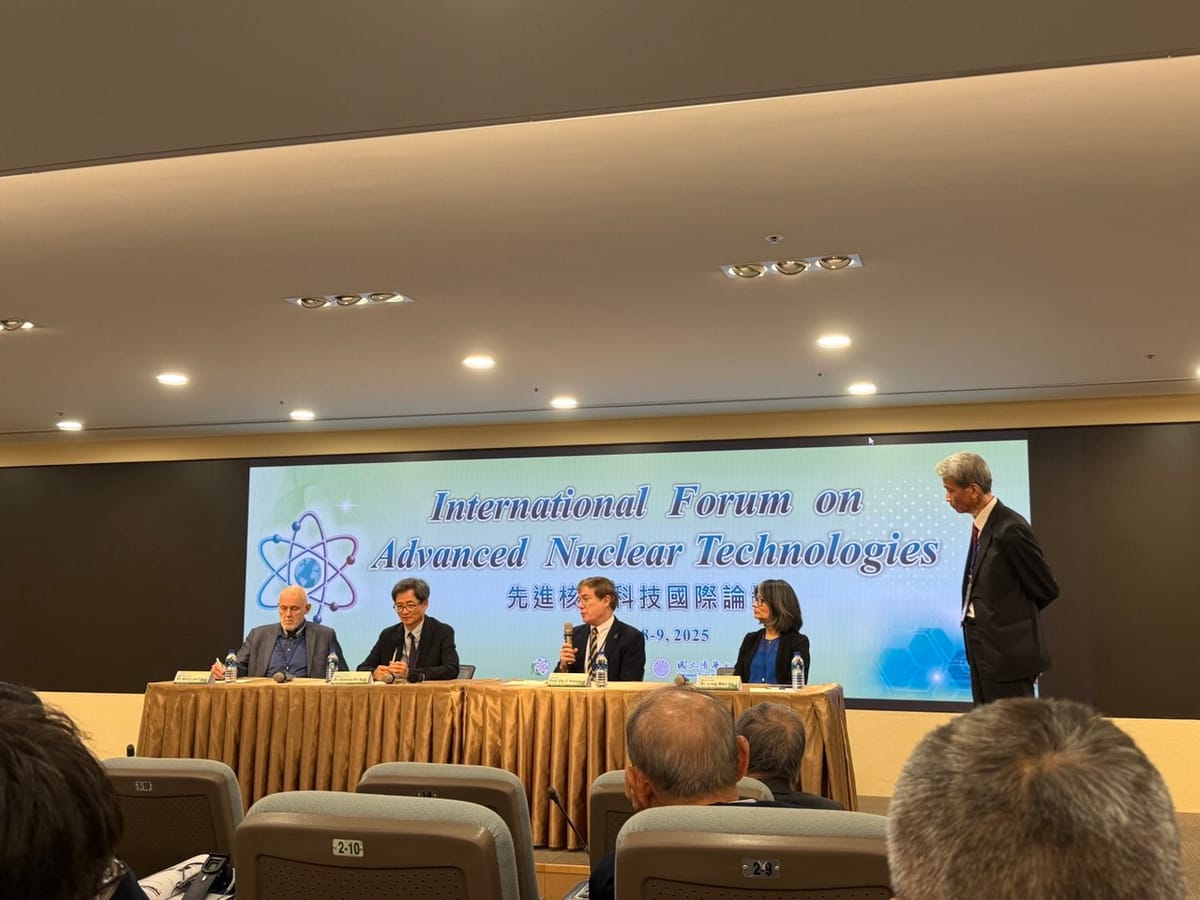
Last month, I had the privilege of attending the International Forum on Advanced Nuclear Technologies in Taipei, convened by Prof. Tsung-Kuang Yeh of National Tsing Hua University. The event featured industry leaders including Dr. Ling-Wen Hu from MIT’s Nuclear Reactor Laboratory and Prof. Per Peterson, Chief Nuclear Officer of Kairos Power.
While the discussions centered on Advanced Fission (MSRs/SMRs), the commercialization challenges they highlighted are universal to Deep Tech. As a founder building Holonomy Systems for the fusion industry, I identified a distinct convergence in our lab-to-market roadmaps.
Here are my 5 strategic takeaways:
1. The Tech Stack Convergence
Dr. Hu demonstrated that Molten Salt Reactors (MSRs) and Fusion reactors share a critical material foundation: FLiBe (Lithium-Beryllium Fluoride). The corrosion and thermal hydraulic challenges being solved for MSRs at 700°C are effectively de-risking the roadmap for fusion breeding blankets.
2. Valuation is Driven by Hardware Certainty
Prof. Peterson provided a masterclass in deep tech financing. Kairos Power didn't secure their 500 MW deployment deal with Google based on simulations alone. They adopted a strategy of iterative hardware demonstrations, building three generations of non-nuclear Engineering Test Units (ETUs) to validate their systems before introducing fuel.
3. Vertical Integration is a Signal of Market Opportunity
One particular slide from Kairos Power stood out: It explicitly stated that they are forced to vertically integrate manufacturing because critical components are not available off-the-shelf. In Deep Tech, this supply chain vacuum represents a prime opportunity for agile startups to step in and provide specialized, high-performance components (such as HTS magnets and sensors).
4. Validation Requires a Sandbox
Prof. Yeh announced NTHU's plan to deploy a Westinghouse eVinci™ micro-reactor on campus. This project will establish a comprehensive ecosystem for operations and digital twins. Access to such a home-ground verification site is crucial for testing radiation-hardened instrumentation in a real-world environment before aiming for the global market.
5. Manufacturing as the Ultimate Moat
From MIT’s requirements for material irradiation testing to Kairos’s use of Electron Beam Welding (EBW) for reactor vessels, the barrier to entry is high-precision manufacturing. The Lesson Learnt The forum reinforced that the path to commercialization for fusion and advanced nuclear is not limited by physics, but by supply chain maturity and hardware iteration cycles.
We are ready to build the missing links.