Field Notes from TPS2026: The Zero-to-One Moment for Taiwan’s Fusion Supply Chain
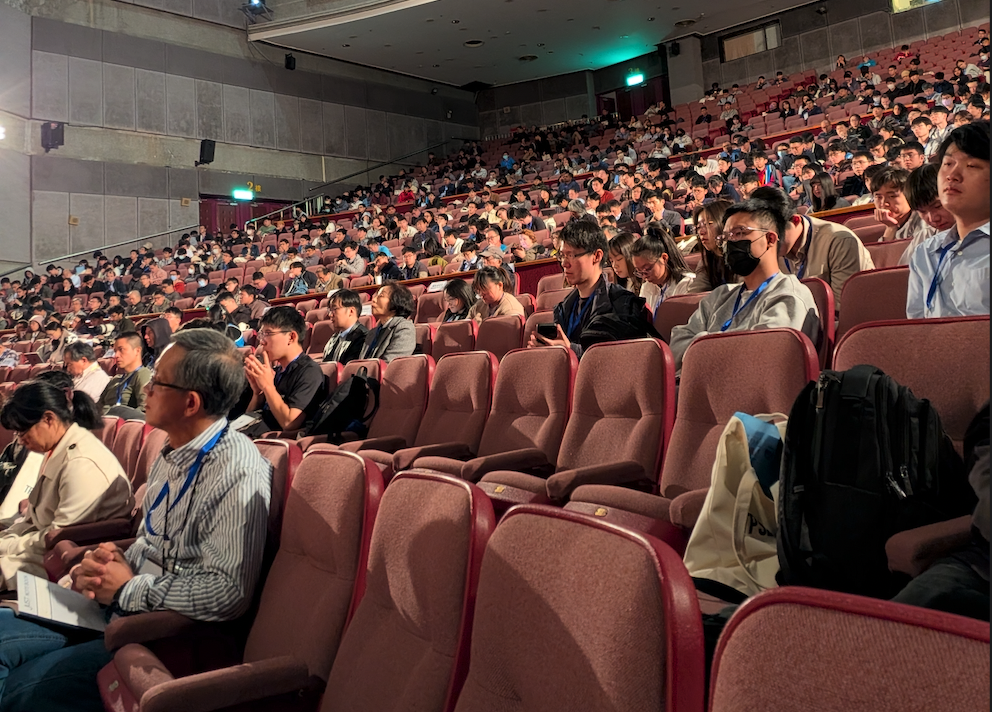
Event: 2026 Annual Meeting of the Physical Society of Taiwan (TPS2026)
Walking through the corridors of TPS2026, you don't see the glitz of a Silicon Valley launch event. There are no venture capital lanyards or flashy demos. Instead, you find rows of A0 posters and heated discussions among graduate students. But it is precisely here, on these paper posters, that I found what the fusion industry has been missing: grounded, executable engineering details.
For years, the fusion narrative has been dominated by the holy grail of infinite energy. But here in Taiwan, I saw engineers tackling the dirty work required to make that grail a reality: How do you measure a plasma that doesn't exist yet? How do you structure a target to make a laser hit 2.7 times harder?
As the founder of Holonomy Systems, my goal here wasn't just to track academic progress, it was to validate a hypothesis: The next battleground in fusion isn't just about who builds the biggest reactor, but who controls the critical subsystems that make them run.
Here are my field notes and supply chain insights from the floor of TPS2026.
1. Magnetic Confinement (MCF): Building the Instrumentation First
The NCKU team is building FIRST (Formosa Integrated Research Spherical Tokamak). Unlike established reactors (like JET or KSTAR), FIRST is in the zero-to-one construction phase. This offers a rare glimpse into the foundational supply chain: before you can confine plasma, you need to build the tools to measure it (Diagnostics) and the systems to protect the machine (Control).
The On-Ground Insight: The focus at the NCKU booth wasn't on record-breaking temperatures because the machine isn't running yet. Instead, it was on instrumentation.
- Diagnostics: They are fabricating 3D B-dot probes using PEEK (a high-performance plastic) to map magnetic fields. Without these "eyes," a tokamak is flying blind.
- Protection: I spent time analyzing a poster on a pneumatic-controlled relay system. This is a specific solution to a massive problem: when a tokamak disrupts, the electromagnetic pulse (EMP) fries standard electronics. Their solution using fiber optics and compressed air for physical isolation is the kind of ruggedized engineering that commercial fusion plants will need.
The Supply Chain Bet: This confirms a niche for fusion-grade Instrumentation. As more private companies build compact tokamaks (like Tokamak Energy or ST40), they will need suppliers for these bespoke, radiation-hardened diagnostics and control relays.
2. Inertial Fusion (ICF): The Razor-and-Blade Opportunity
While MCF builds cages for plasma, Inertial Confinement Fusion (ICF) blasts it with lasers. The National Central University (NCU) team is pursuing Proton-Boron fusion. This fuel is abundant and produces no radioactive neutrons, but it is notoriously difficult to ignite.
The On-Ground Insight: The most commercially significant data point of the conference came from the NCU High-Field Physics group. They presented data showing that structure dictates performance.
- The Breakthrough: Using 3D PIC simulations and experiments, they demonstrated that Nanowire (NW) targets significantly outperform standard flat targets. Under identical laser conditions, the nanowire structure increased the electron temperature from 0.92 keV to 2.50 keV—a 2.7x efficiency gain.
- The Science: This work aligns with their broader research into tailored targets, such as using asymmetric gas density profiles to enhance electron beams, a technique published by the group in Physics of Plasmas.
The Supply Chain Bet:
This validates the advanced target foundry model. Future laser fusion plants will operate at high repetition rates (10 Hz+), consuming nearly a million targets a day. The manufacturing of these nanowire targets requires Lithography, Etching, and MEMS—technologies that define Taiwan's semiconductor prowess. This is a clear entry point for Taiwan into the global fusion supply chain.
3. Simulation: The In-Silico Advantage
In the era of NVIDIA Omniverse and Google DeepMind, digital twins are essential. But AI models are only as good as the physics governing them.
The On-Ground Insight: I was impressed by the end-to-end Simulation Platforms presented.
- NCU has built a pipeline connecting Laser Parameters -> WarpX PIC -> Target Heating -> Fusion Rate. This allows them to iterate on target designs in silico before manufacturing.
- NCKU showed a startup model that calculates eddy currents to prevent misfires during the delicate plasma breakdown phase.
- Theoretical Depth: Researchers also presented a refined analytic framework for ITG (Ion Temperature Gradient) instabilities, offering a faster alternative to heavy gyrokinetic codes.
The Supply Chain Bet:
This is Simulation-as-a-Service. Hardware startups often lack the in-house physics depth to model specific phenomena like p-B stopping power or tokamak startup transients. Packaging these validated codes as commercial tools is a low-CapEx, high-value opportunity.
Conclusion: Three Bets on the Supply Chain
Leaving TPS2026, I see a clear distinction between hype and work. The work being done in Taiwan points to three specific supply chain opportunities:
- Advanced Target Foundry: Leveraging semiconductor processes to mass-produce nanostructured targets for global ICF experiments.
- Ruggedized Control Components: Commercializing EMP-proof relays and sensors for the growing fleet of compact tokamaks.
- Specialized Simulation Services: Exporting validated physics models to help hardware companies design faster.
The blueprints are drawn. It’s time to build.
Appendix: Key References & Session Materials
Cross-referenced with TPS2026 Agenda and On-Site Materials
I. Magnetic Confinement Fusion (MCF) - The FIRST Project
- Control Systems: Development of pneumatic-controlled relay system for Formosa Integrated Research Spherical Tokamak (FIRST) – Bing Huang He et al.
- Power Electronics: Development of the Current-Driver Module for the Coils of a Tokamak – Jean Nelson, Che-Men Chu et al.
- Diagnostics: Development of 3D B-dot probes for measuring magnetic fields in a Tokamak – Keng-Yu Lin et al.
- Diagnostics (Advanced): Development of ECE/EBE Radiometer for Te(R,t) Measurements on FIRST – Tzu-Chi Liu, Eiichirou Kawamori et al.
- Simulation (Start-up): Development of the tokamak startup model... in mini-Tokamak – Yung-Wei Pi et al.
- Simulation (Instability): Ion-Temperature-Gradient Instability in Tokamak Plasmas: A Refined Analytic Framework – Chien-Chung Hsu, Shih-Hung Chen et al.
II. Inertial Confinement Fusion (ICF) & Proton-Boron Research
- Nanostructure Targets: Our 3D PIC simulation results show the Boron can be almost fully ionized using nanostructure – Wang et al., 2025 APS DPP meeting.
- Related Context: See also "Proton–boron fusion in femtosecond-laser-irradiated nanowire array target" (Wang et al., Physics of Plasmas context).
- Laser-Plasma Interaction: Enhancing Betatron Radiation from Few-TW LWFA via an Improved Asymmetric Target Density Profile – Dang Khoa Tran, Po-Wei Lai, Shih-Hung Chen, Ming-Wei Lin et al..
- Related Publication: Tran, D. K., et al. "Enhanced pointing from few-TW laser wakefield acceleration" Physics of Plasmas, 2024.
- Simulation Platform: Our Core Capability: A Validated, End-to-End Simulation Platform – NCU Team.
- Targetry Strategy: In-target p-B fusion (Solid vs Gas-cluster).
- Physics Modeling: Modeling the Enemy: Validating Our Stopping Power Calculations (Poster P2-PP-026).
III. Invited Plenary & Special Talks
- Tokamak Physics: Physics of Fusion Plasmas and Experiments in the TST-2 Spherical Tokamak – Akira Ejiri (University of Tokyo).