FusionX:APAC 2026: How APAC Is Entering Fusion, and Where Taiwan Fits
Four countries' angles, value before the first power plant, and one ask
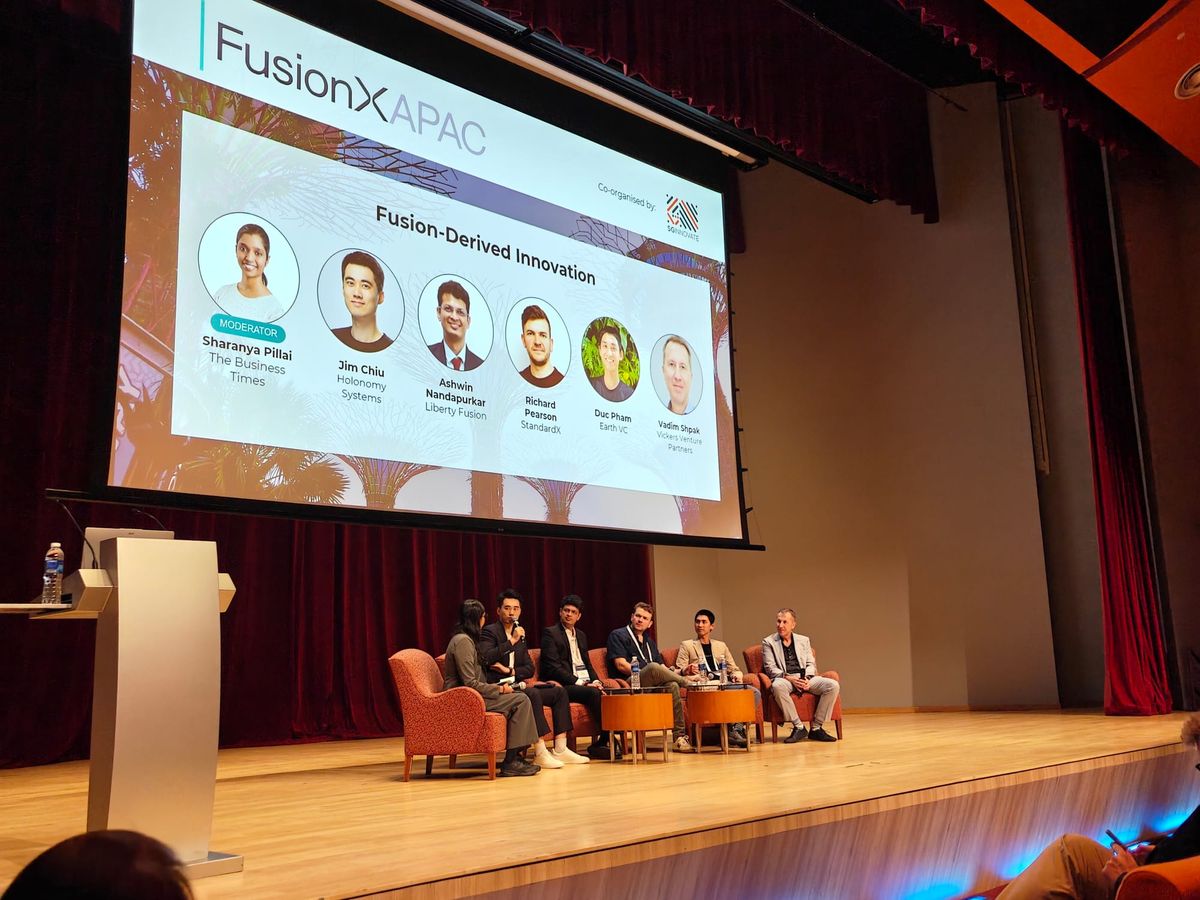
These are first-hand notes from FusionX:APAC in Singapore (30 September to 2 October 2026), where I spoke on the Fusion-Derived Innovation panel. Three things stood out.
- Fusion is already creating value before the first power plant
- APAC countries are each picking a different angle on fusion
- Taiwan has a fusion research program and a position in a supply chain fusion will need, but no seat at the table yet
1. Fusion is creating value before the first power plant
The panel I spoke on was called Fusion-Derived Innovation, and the most useful framework came from my co-panelist Richard Pearson. He split fusion's early value into two kinds. The first is technology built for fusion that finds other markets, such as lasers and magnets. The second is companies that treat fusion as one market among several. In his words: "And then you've got companies like StandardX that say, actually, we think that is a market vertical."
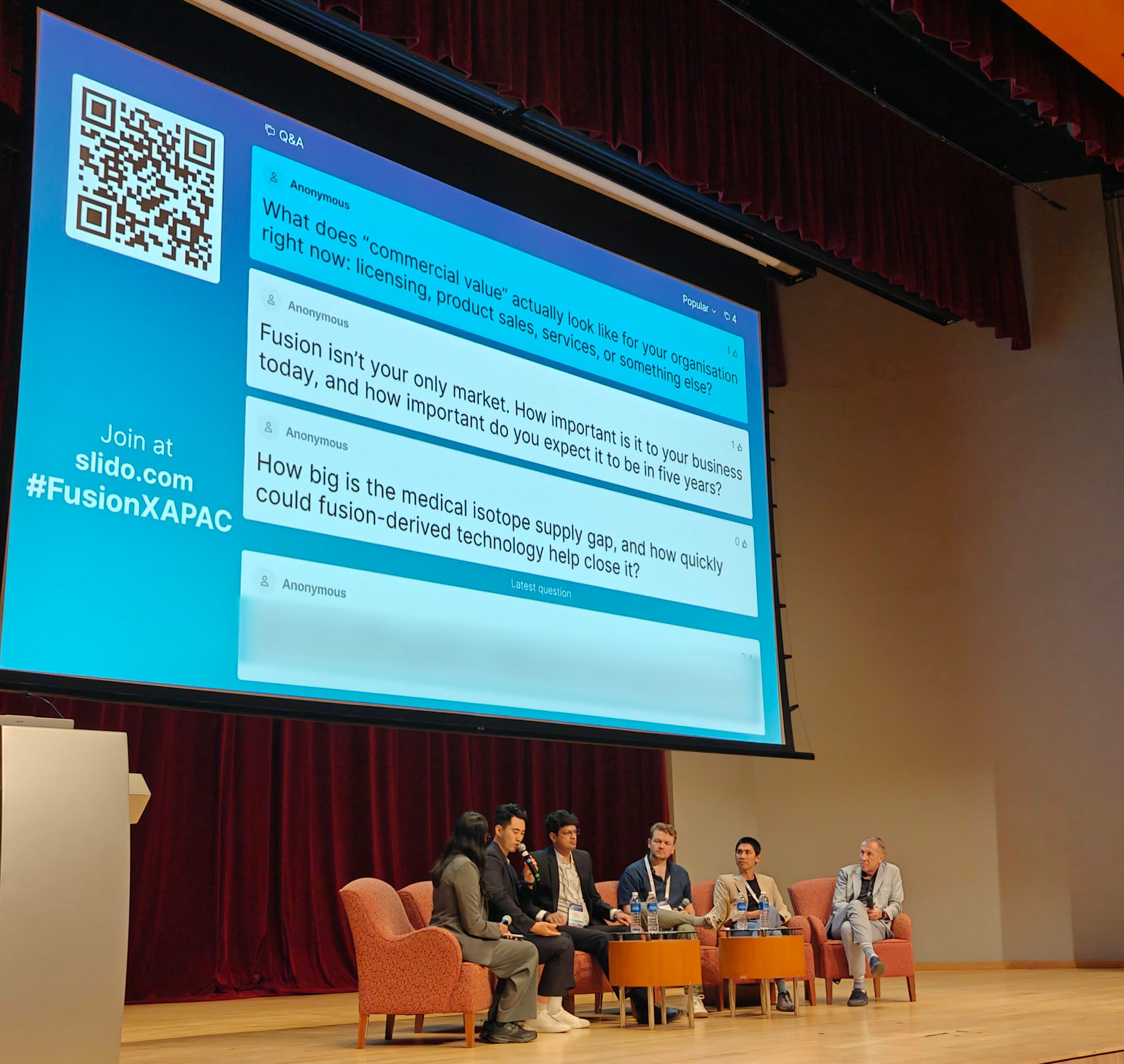
Both kinds are real. Kyoto Fusioneering is already taking orders outside fusion; StandardX is still building, with first deliveries planned for 2027.
Technology born from fusion. Kyoto Fusioneering, which Richard co-founded, announced its first gyrotron order from outside fusion in September, for Quaise Energy's geothermal drilling. Nicolas Burkardt of Marvel Fusion said the same of lasers: "On the laser side, one very fortunate element is that we can already sell those technologies for adjacent markets, non-fusion market." He named container screening, radioisotopes and dual-use applications. HB11, a laser-fusion company in Australia, is trying the same.
Fusion as a market. Richard's own company, StandardX, is building what he called "the world's first isotope refinery." It announced a £10 million seed round in September. Its isotopes go to cancer care first, with pilot production and first deliveries to a medical research partner planned for 2027, and to fusion fuel later. "We're doing something where there's value today," he said.
Investors differ on how much weight this carries. For Neil Fong it is upside: "These all have very real commercial applications today. And we're not obviously banking on that, but that's a nice development." Vadim Shpak of Vickers Venture Partners, also on my panel, backs only the supply-chain side and stays away from reactor companies: "So fusion supply chain, totally investable." Saemin Ahn of Rakuten Capital expects money to follow a milestone the market can read, and then to go looking for suppliers: companies with better ways to produce tritium, or "baskets" of companies developing raw materials for HTS magnets. The catch is the clock. Duc Pham of Earth VC: "Unfortunately, fusion is still way beyond our fund cycle."
The moderator closed my panel by asking why the everyday person should care about fusion. Vadim answered first: "They don't need to care. They need to care about results. Clean, cheap energy." My answer made the same point as Richard's: "Why should we care about going to Mars? Because we actually get more out of the process than … just the destination itself."
2. APAC is picking its angles
Japan, Korea and China are the region's best-known fusion players and are well covered elsewhere, so I'll leave them aside. The interesting comparison is among countries still choosing how to enter. I'll take them mostly through the people who were on stage.
| Country | Angle | Who is moving | What's next |
|---|---|---|---|
| Singapore | The state picks its place in the value chain | A*STAR and ST Engineering on CFS's SPARC; A*STAR's diagnostic for Realta; Temasek in CFS; SGInnovate in Focused Energy | The minister has asked his team to study a fusion-hub proposal |
| India | The law opens first | The SHANTI Act opened nuclear to private players in December 2025 | FusionX:India, Bangalore, 26–27 November |
| Australia | Money before policy | No national strategy, yet a pension fund holds a stake in CFS, and a laser-fusion startup is building defense lasers to help fund its fusion work | FusionX:Australia, Sydney, 6 October |
| Taiwan | Research money, not yet in the room | A government-funded research program, including Taiwan's first tokamak | See section 3 |
Singapore: the state picks its place
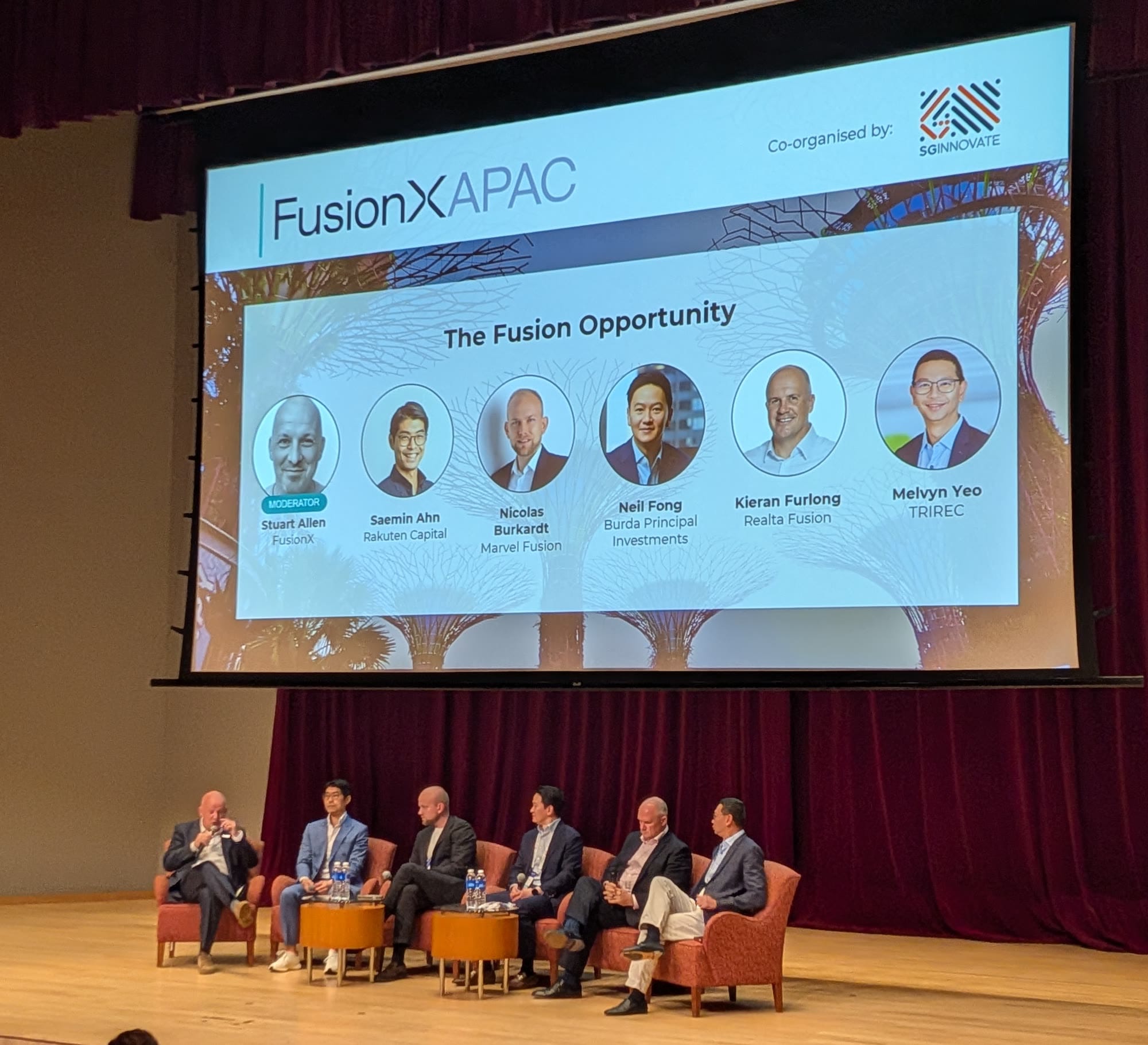
Minister Tan See Leng opened the conference. His framing was precise: Singapore has no fusion reactor of its own, and it can still take a role in the value chain, through capabilities it already has in precision engineering, advanced manufacturing and plasma diagnostics. Then he listed the proof. A*STAR and ST Engineering have produced components for Commonwealth Fusion Systems' SPARC device. A*STAR delivered a diagnostic tool to Realta Fusion. And when the morning's roundtable proposed Singapore as a fusion hub, he said he had "asked my team to seriously consider this."
The capital is already in. Rick Needham of CFS said on stage: "Obviously, Temasek is an investor in ours from the very early days." SGInnovate, the conference co-host, is an investor in Focused Energy.
Two speakers on the opening panel explained why a small country can lead anyway. Kieran Furlong of Realta Fusion said the bigger power governments have is regulation: "It's the power of the pen, right?" Neil Fong of Burda Principal Investments went further. Singapore is already seen as a policy model in Southeast Asia, he said, and once commercial power plants arrive, "Singapore will most likely take the lead on policy."
India: the law opens first
On my own panel, Ashwin Nandapurkar of Liberty Fusion was direct about the private side: "So fusion is very recent in India." The reason is legal. Until the SHANTI Act became law in December 2025, nuclear energy in India was closed to private companies, and Ashwin noted that the rules for putting it into practice are not out yet. He pointed to space as the precedent: once India opened that sector, "we have about 220 companies now in the last seven years which have come up." Public research is older. India is an ITER member, and its Institute for Plasma Research, a Department of Atomic Energy institute that runs two tokamaks, is among the organisations listed for FusionX:India in Bangalore in November.
Australia: money before policy
Australia has no national fusion strategy. HB11 Energy's CEO, Warren McKenzie, has called it "the only major western country that doesn't have a fusion strategy." Yet the money moved first. The pension fund Hostplus holds a stake in CFS that ABC put at about 4% in 2025. HB11, a laser-driven hydrogen-boron fusion company, is building a defense-laser business to help fund its fusion work. Alex Borovskis, who moderated the supply-chain panel in Singapore, co-founded Helixos, a partner of FusionX:Australia in Sydney on 6 October.
3. Taiwan: a research program, and a position in a supply chain fusion will need
Taiwan came up on my panel because the moderator asked me about it. Here is what I would have liked to say in full.
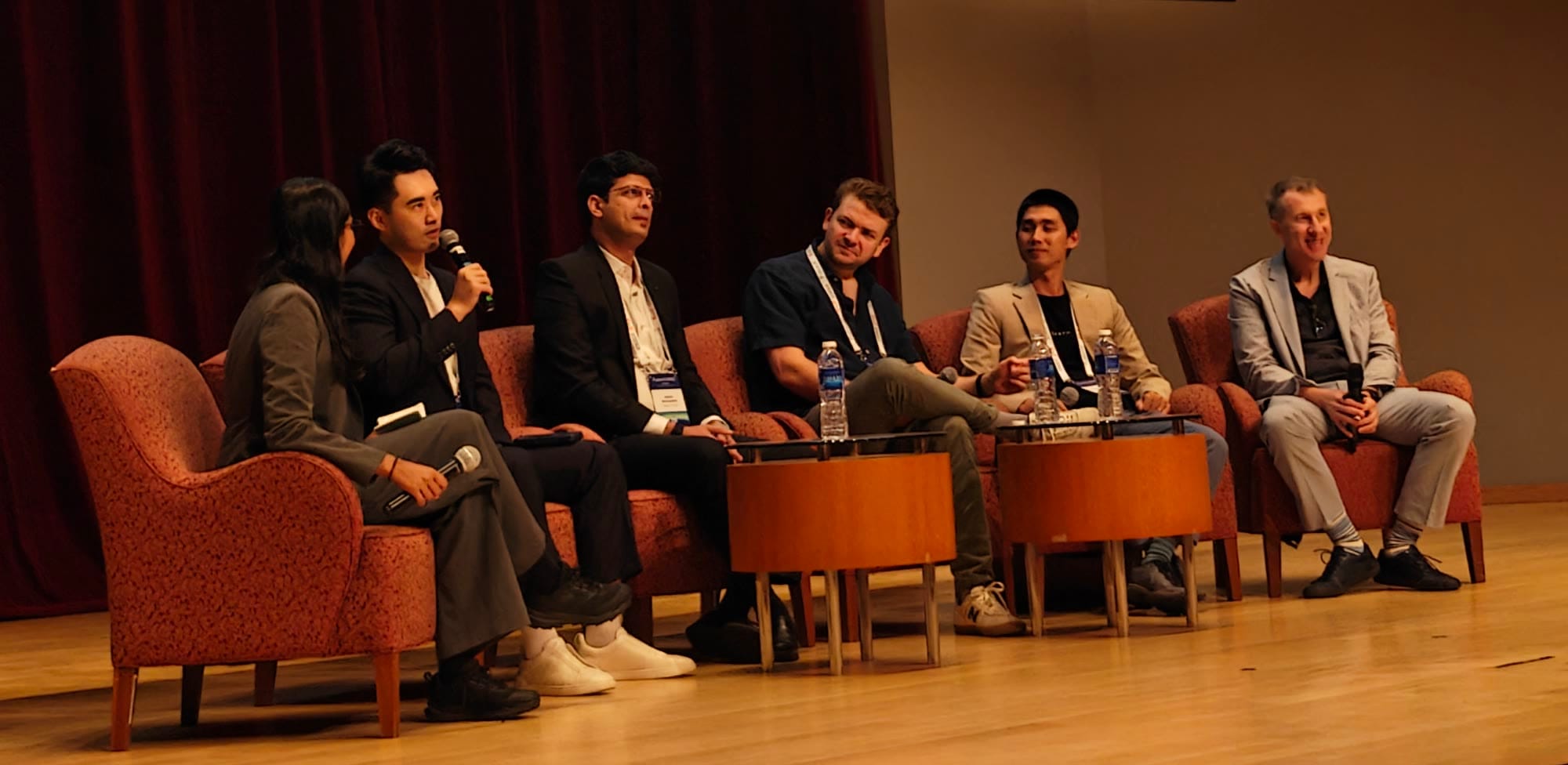
Taiwan has a government-funded fusion research program. Since 2023, the National Science and Technology Council has put about NT$250 million (roughly US$8 million) into fusion research on two tracks: laser-driven experiments at National Central University, and a magnetic-confinement program led by the National Atomic Research Institute with National Cheng Kung University, National Tsing Hua University and the national high-performance computing center. That program is building FIRST, Taiwan's first tokamak, a spherical device about two metres tall in Taoyuan. Its first goal is about 100 eV, around a million degrees, with operation testing planned for 2026–27.
The policy door is open, carefully. The government says it is open to advanced nuclear, including fusion and small modular reactors, if safety, waste and public-consensus conditions are met. The Premier said in August that the Cabinet's 2027 budget proposal includes some funding to explore fusion with international partners. Taiwan is not an ITER member, and fusion does not yet appear in its 2030 energy transition white paper.
The industrial position is the part that matters most. Most laser-fusion power plant designs built on solid-state lasers need high-power pump diodes in volumes no factory makes today. Lawrence Livermore's LIFE studies put the need at up to about 50 GW of peak diode power per plant; at 1 kW per bar, that is roughly 50 million laser bars. Those diodes are built on gallium-arsenide wafers, and today most are made as edge-emitting bars, cleaved and mounted one bar at a time, largely by integrated manufacturers. If pump lasers come to be made and tested on the wafer, the way chips are, gallium-arsenide foundries are a natural place to make them. That is a business Taiwan already leads: WIN Semiconductors alone held about 59% of the GaAs foundry market in 2024, and in 2022 CommonWealth Magazine put WIN and AWSC together at over 90%. Add the island's precision-manufacturing base, and Taiwan has more to offer fusion's supply chain than its fusion budget suggests. In Richard's terms, Taiwan's GaAs foundries would be the second kind: companies for which fusion is one more market.
What Taiwan does not have yet is the room. FusionX has held events in Tokyo, in Korea and twice in Singapore, and goes to Sydney and Bangalore next. As far as I could tell, I was the only speaker from Taiwan on the programme in Singapore. The interest at home is there: a fusion forum in Taipei in May 2025 drew nearly 300 people. Taiwan's compound-semiconductor and precision-manufacturing companies, and the research teams building FIRST, belong in the regional conversation.
So I'll repeat what I said on stage: "FusionX, you guys should really come to Taiwan."
Sources
On stage at FusionX:APAC, Singapore, 1 October 2026 (programme)
- The Fusion Opportunity: Kieran Furlong (Realta Fusion), Neil Fong (Burda Principal Investments), Nicolas Burkardt (Marvel Fusion), Saemin Ahn (Rakuten Capital).
- From Seed to FOAK: Rick Needham (Commonwealth Fusion Systems).
- Fusion-Derived Innovation, moderated by a Business Times correspondent: Richard Pearson (StandardX), Ashwin Nandapurkar (Liberty Fusion), Vadim Shpak (Vickers Venture Partners), Duc Pham (Earth VC) and the author.
Singapore
- Opening remarks by Minister Tan See Leng at FusionX:APAC 2026 (1 October 2026), paragraphs 21–22, 24, 27–28 and 35–37.
- A*STAR and Commonwealth Fusion Systems sign a collaborative research agreement (20 May 2026).
- The future of fusion energy: What will it take to bring the power of the stars to earth? (SGInnovate).
India
- Lok Sabha passes SHANTI Bill (World Nuclear News, December 2025); President gives assent to SHANTI Bill (News on AIR, 22 December 2025).
- ITER members; Institute for Plasma Research; FusionX:India.
Australia
- Nuclear fusion energy startup HB11 Energy looks to the US as Australia sits out (SmartCompany, 23 May 2025).
- The Australians in the race for fusion energy (ABC, 13 October 2025).
- HB11 Energy awarded A$22M laser project (May 2022); FusionX:Australia.
Value before the first power plant
- Kyoto Fusioneering to supply a gyrotron system to Quaise Energy (29 September 2026).
- Unlocking the Fusion Industry Supply Chain, with Kyoto Fusioneering's Richard Pearson (TAE).
- StandardX launches with £10M seed round (23 September 2026).
Taiwan
- Research funding: Liberty Times and Liberty Times (14 June 2026); Taipei Times (15 June 2026).
- FIRST: Rti (17 May 2024); Executive Yuan policy report, p. 106 (September 2026).
- Policy: Executive Yuan oral policy report (24 February 2026); CNA (22 March 2026); Executive Yuan (26 August 2026).
- 2030 Energy Transition White Paper (Ministry of Economic Affairs, 2026); ITER members.
- Taipei fusion forum: energy-omni (16 May 2025).
Supply chain
- Pump diodes: Crump, Fenwick et al., Diode laser pumps for future inertial fusion energy systems, Optics Express 33, 46456 (2025); LLNL copy on OSTI.
- GaAs foundry share: MoneyDJ on WIN Semiconductors (2024 figure); CommonWealth Magazine (24 August 2022).
FusionX events