Three Observations from FIA Annual Policy Conference 2026: Why the Fusion Race Is a Supply Chain Race

At the FIA Annual Policy Conference this week, a panelist mentioned a number and the room went quiet. China has mobilized an estimated $6.5 billion for fusion since 2023. It stood up a state-backed national champion with $2.1 billion in registered capital last July. It is producing ten times as many fusion PhDs as the United States annually.
Multiple speakers used the word "Sputnik." I think they're right. But I also think the Sputnik framing, on its own, leads to an incomplete response.
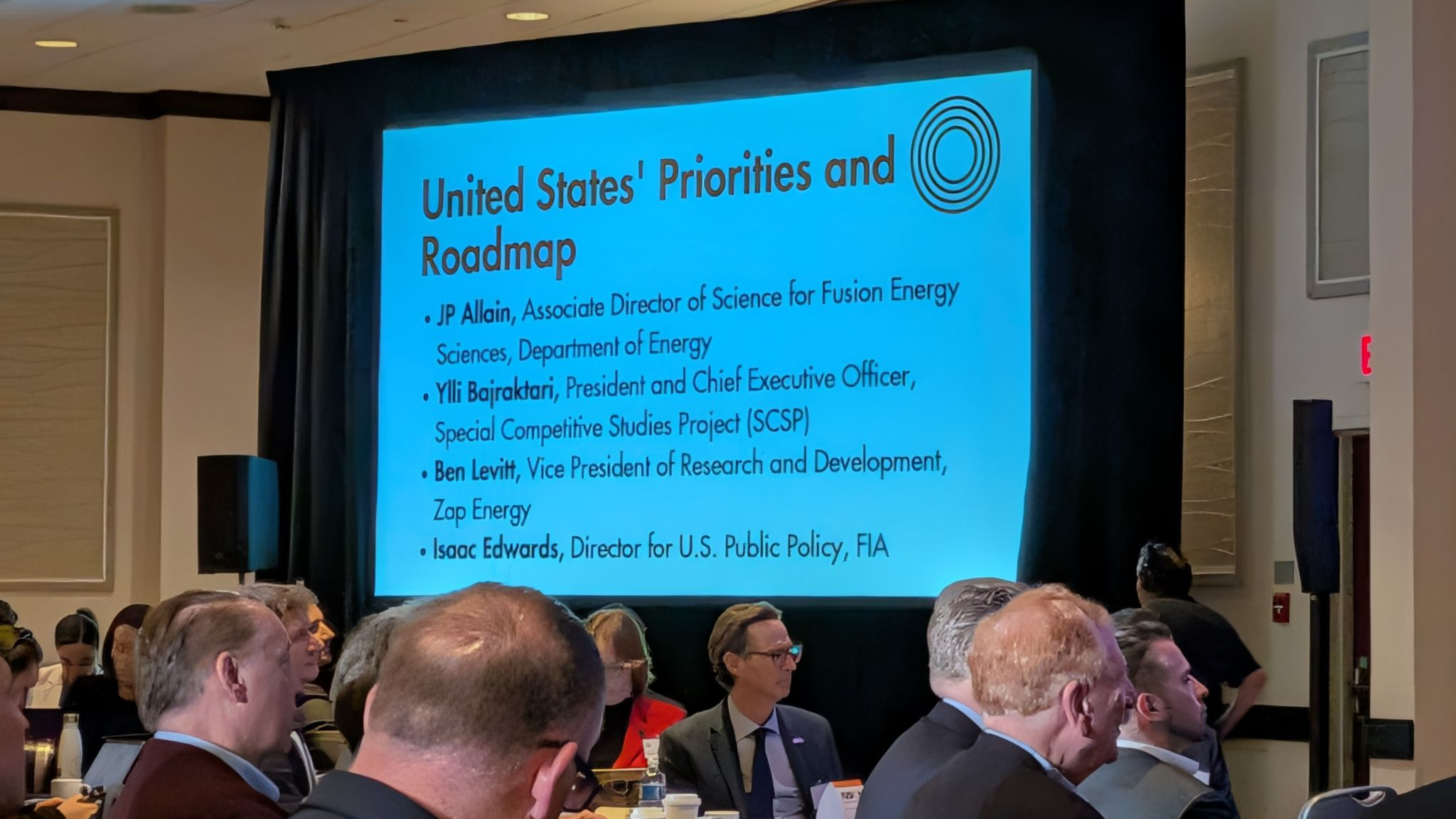
Real policy progress. But the manufacturing gap remains.
The U.S. is not standing still. DOE created a standalone Office of Fusion late last year, elevating the sector to parity with AI and quantum. The NRC published its first proposed regulatory framework for fusion machines three weeks before the conference. A bipartisan commission is calling for $10 billion in federal investment. Under Secretary for Science Dario Gil has been unambiguous: fusion is a top-three national priority.
This is real progress. But the bottleneck that will determine who wins the fusion race is not policy architecture. It is manufacturing. The industrial layers between proven plasma physics and deployable power systems have not been built. Fusion companies grew their supply chain spending 73% in 2024, reaching $434 million. Yet 83% of suppliers still view fusion business as risky. The gap between scientific ambition and industrial readiness is not shrinking. It is becoming more visible as timelines compress.
The Milestone-Based Development Program, modeled after NASA's commercial crew partnerships, illustrates the disconnect. Congress authorized $415 million. Less than $98 million has been appropriated. The private sector has committed nearly $9.8 billion to fusion overall. Federal commitment to the specific program designed to bridge science and commercialization is running far behind the ambition.
The response is alliances, not just appropriations
The Sputnik analogy is useful for generating urgency. It is less useful as a strategic blueprint. The original Sputnik response was a domestic mobilization. This one cannot be.
America wins technology races through alliances. The semiconductor industry proved this. AUKUS is proving it in defense. Fusion supply chains will follow the same pattern, because no single country controls all the manufacturing capabilities required to build a commercial fusion power plant.
Yet the current U.S. fusion policy framework is almost entirely domestic in orientation. The Office of Fusion, the Milestone Program, the DOE roadmap — none yet includes a structured mechanism for allied manufacturing partners to participate. The U.S. is building a strong national fusion strategy. The next step is making it an allied one.
One of the most overlooked assets for this effort sits in plain sight: the compound semiconductor ecosystems of Japan and Taiwan.
Japan brings deep expertise in precision optics, advanced materials, and system integration. It has also committed ¥400 billion to a national fusion strategy, signaling long-term demand pull from Asia's largest advanced manufacturing economy.
Taiwan adds the volume manufacturing layer. Some of the world's most advanced III-V compound semiconductor foundries operate there — mature, volume-production facilities with decades of epitaxial growth and device packaging expertise. The same fabrication infrastructure that builds telecom VCSELs, defense photonics, and power electronics can produce the photonic components that laser-driven fusion will require at scale.
Together, these allied ecosystems represent capability that would take a decade and tens of billions of dollars to replicate domestically.
The specific gap: laser pump modules at scale
This matters across fusion approaches, but the scale challenge is sharpest for laser-driven inertial confinement fusion. A single ICF power plant requires approximately 50 GW of peak diode pump power. That translates to roughly fifty million diode pump modules, nearly three times the current global annual production capacity of diode bars. Diode pumps account for 33–50% of laser driver system cost. Packaging accounts for over half of diode cost.
Building these modules at scale is fundamentally a compound semiconductor manufacturing problem: epitaxial growth, wafer-level processing, die bonding, thermal packaging. These are exactly the core competencies of Taiwan's III-V foundry ecosystem. The industrial capability to fill this gap exists. It just hasn't been connected to the fusion supply chain.
The standardized manufacturing layer that produces these modules at the price points fusion requires does not exist today — not in the U.S., not in China, not anywhere. The existing industry structure will not build it spontaneously, because the companies with the technical capability to do so are vertically integrated. Standardizing the pump module layer would erode their margins. They have no incentive to change.
This is not a technology problem. It is a structural vacancy in the supply chain.
What we're building
I started Holonomy Systems to fill this vacancy. We design standardized laser pump modules in the U.S. and manufacture them through Taiwan's III-V semiconductor ecosystem, riding the semiconductor cost curve toward the price points fusion requires. Our dual-entity structure — U.S. IP and compliance, Taiwan semiconductor manufacturing — is itself a small-scale proof of concept for what an allied fusion supply chain can look like.
The architecture is deliberately dual-use. The same module serves defense laser systems today and fusion laser drivers tomorrow. Near-term revenue from defense programs funds the early production doublings that drive unit costs down. The learning curve is well-characterized: a verified 60% rate, meaning each doubling of cumulative production yields a 40% cost reduction. Current costs sit at $0.30–1.30 per watt. Fusion needs below $0.01 per watt. The math works if you start early enough and let compounding do its job.
Every module we ship carries embedded telemetry, building the first fleet-scale degradation dataset in the industry. That data compounds with volume and cannot be replicated by latecomers.
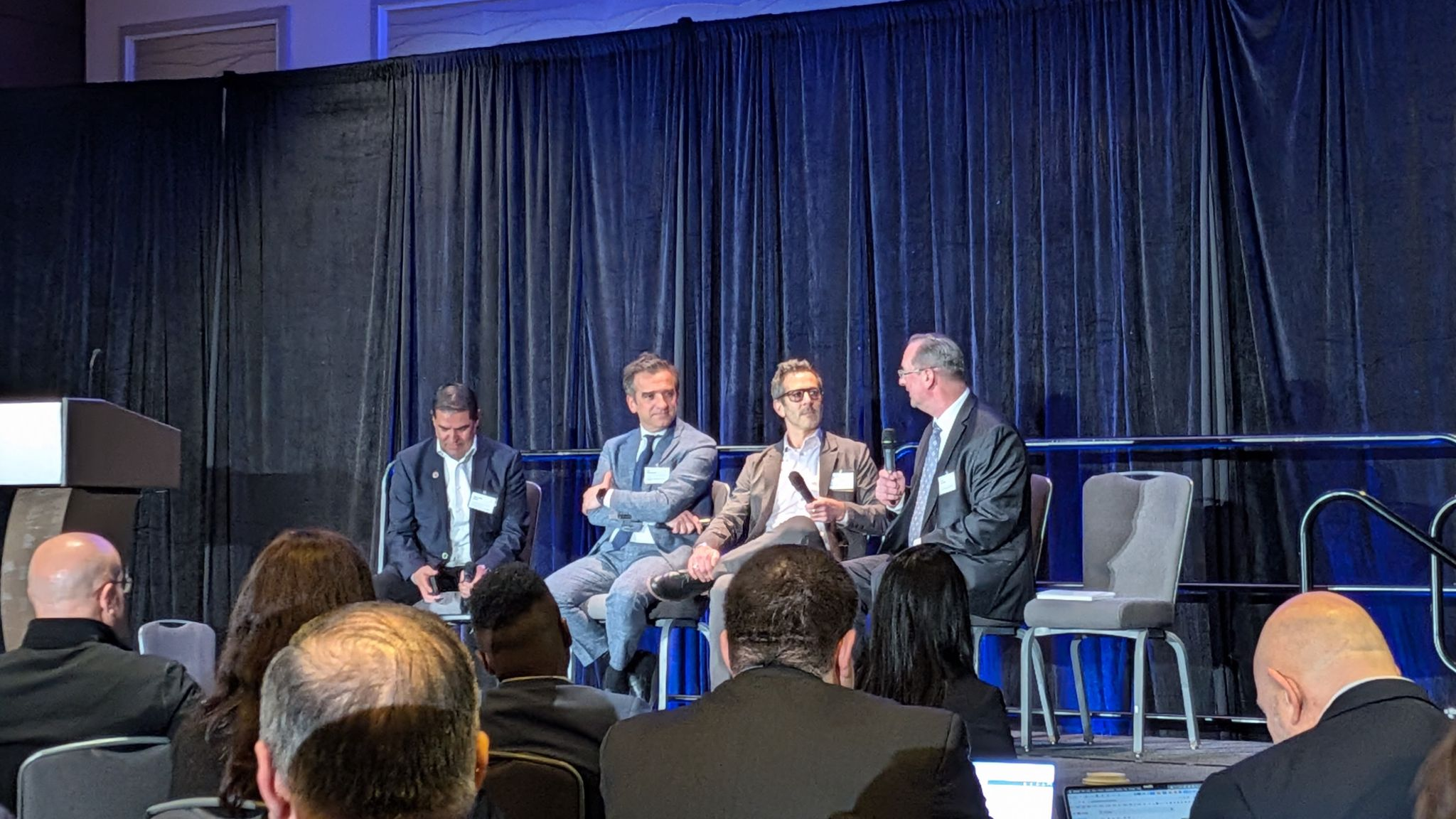
The fusion race is a supply chain race
The FIA conference this year marked a turning point. The conversations in the hallways have shifted. A year ago, panels debated confinement approaches and plasma parameters. This year, they debated lithium-6 enrichment, HTS wire sourcing, tritium availability, and workforce pipelines. The community has internalized what NIF's ignition shots proved: the physics works. What remains is engineering and manufacturing.
The country that builds the manufacturing layers first does not just win a technology race. It sets the standards, captures the margins, and locks in the supply chain relationships that define the industry for decades. Alliances accelerate this. They distribute risk, access existing industrial capacity, and create interdependencies that strengthen over time.
The fusion supply chain will not be built by one country in isolation. It will be built by the alliance that moves first.
References
- Special Competitive Studies Project (SCSP), "Fusion Power: Enabling 21st Century American Dominance," February 2025. Estimates on China's $6.5B fusion mobilization, 10× PhD output, and recommendation for presidential Executive Order.
- Xinhua News Agency, "China sets up state-owned fusion energy company," July 24, 2025. China Fusion Energy Co. (CFEC) established with $2.1B registered capital under China National Nuclear Corporation.
- U.S. Department of Energy, "Energy Department Announces Fusion Science and Technology Roadmap to Accelerate Commercial Fusion Power," October 16, 2025. DOE "Build–Innovate–Grow" strategy and "Seed Fusion Supply Chains" as a top-ten action item.
- U.S. Nuclear Regulatory Commission, Proposed Rule: 10 CFR Part 30, Regulatory Framework for Fusion Machines, Federal Register, February 26, 2026. First proposed regulatory classification of fusion machines as particle accelerators.
- Congressional Research Service, "Toward Commercial Fusion Energy: Considerations for Congress," Report R48866, 2026. Milestone Program authorization ($415M) vs. appropriation (<$98M); FES FY2026 enacted funding ($806M).
- Fusion Industry Association, "The Fusion Industry Supply Chain 2025," June 2025. Supply chain spending growth of 73% to $434M in 2024; 83% of suppliers viewing fusion business as risky.
- Fusion Industry Association, FIA Annual Policy Conference 2026 program, March 18–19, 2026, JW Marriott, Washington, DC. Conference agenda, speaker lineup, and panel topics.
- Senators Padilla & Cornyn, "Office of Fusion Act of 2025," S.3437 / H.R. 6709, 119th Congress, December 2025. Bipartisan legislation to codify the Office of Fusion.
- Crump, P. & Fenwick, S., STARFIRE Diode Technology Working Group Review, Optics Express, December 2025. Verified 60% learning rate for diode laser manufacturing; current cost range $0.30–1.30/W.
- Deri, R. J. et al., "Semiconductor Laser Diode Pumps for Inertial Fusion Energy Lasers," LLNL-TR-465931, Lawrence Livermore National Laboratory. Diode arrays as ~60% of LIFE driver cost; IFE target <$0.01/W.
- Bayramian, A. J. et al., "Compact, Efficient Laser Systems Required for Laser Inertial Fusion Energy," Fusion Science and Technology, Vol. 60, 2011. IFE plant-scale diode pump power requirements (~50 GW peak).
- Government of Japan, National Fusion Energy Strategy, 2024. ¥400 billion commitment to fusion energy development.