How Far? 15 Engineering Gaps Between Fusion Ignition and a Working Power Plant
On April 7, 2025, the National Ignition Facility produced 8.6 megajoules of fusion energy from 2.08 megajoules of laser input. Target gain: 4.13. Tenth confirmed ignition shot. Highest yield in sixty years of inertial confinement fusion.
The physics works. That question is settled.
The question that now organizes the entire inertial fusion energy community is different, and harder: how far does the engineering stand from a working power plant?
I spent the past several months building a quantitative answer, drawing on peer-reviewed literature, DOE program documentation, and national laboratory reports, and grounded by what I observed firsthand at the 2026 U.S. IFE Conference in Washington DC. For each of the fifteen critical subsystems a laser-driven IFE power plant requires, I identified what has been experimentally demonstrated, what a power plant needs, and the factor between them. Every number was verified against its primary published source. The full analysis is available as a white paper; this post presents the core findings.
The short version: IFE is closer to a power plant than skeptics assume, and further than optimists claim.
What has been proven
Two things are now established beyond serious dispute.
First, the physics path is credible. NIF uses indirect drive, bouncing laser light off hohlraum walls, which caps coupling efficiency at roughly 15%. A power plant needs target gains of 30–100×. The path to those gains runs through broadband direct drive, which couples more than 90% of laser energy directly to the fuel. At Rochester's Laboratory for Laser Energetics, direct-drive implosions on OMEGA have reached 89% of the Lawson parameter required for ignition when scaled hydrodynamically to megajoule energies. Trickey et al. have published explicit scaling laws showing gain of approximately 100 is achievable at ablation pressures exceeding 200 Mbar. The FLUX broadband laser technology that makes this possible, delivering UV bandwidth an order of magnitude beyond existing ICF lasers, has been demonstrated at OMEGA scale. A megajoule-scale broadband facility does not yet exist, but the physics predictions are detailed and specific.
Second, the institutional ecosystem has organized with unusual speed. The DOE funded three IFE Hubs in December 2023 for $42 million. The STARFIRE Diode Technology Working Group expanded in September 2025 to include essentially every major high-power laser diode supplier on the planet. The UK launched UPLiFT, a national laser IFE program whose DiPOLE laser has achieved 146 J at 10 Hz with wall-plug efficiency approaching 20%. Germany committed more than €2 billion to fusion by 2029. Colorado State University broke ground on ATLAS, a $150 million, nearly 7-petawatt extreme photonics facility opening in 2027. Inertia Enterprises raised $450 million. Xcimer Energy has raised more than $120 million.
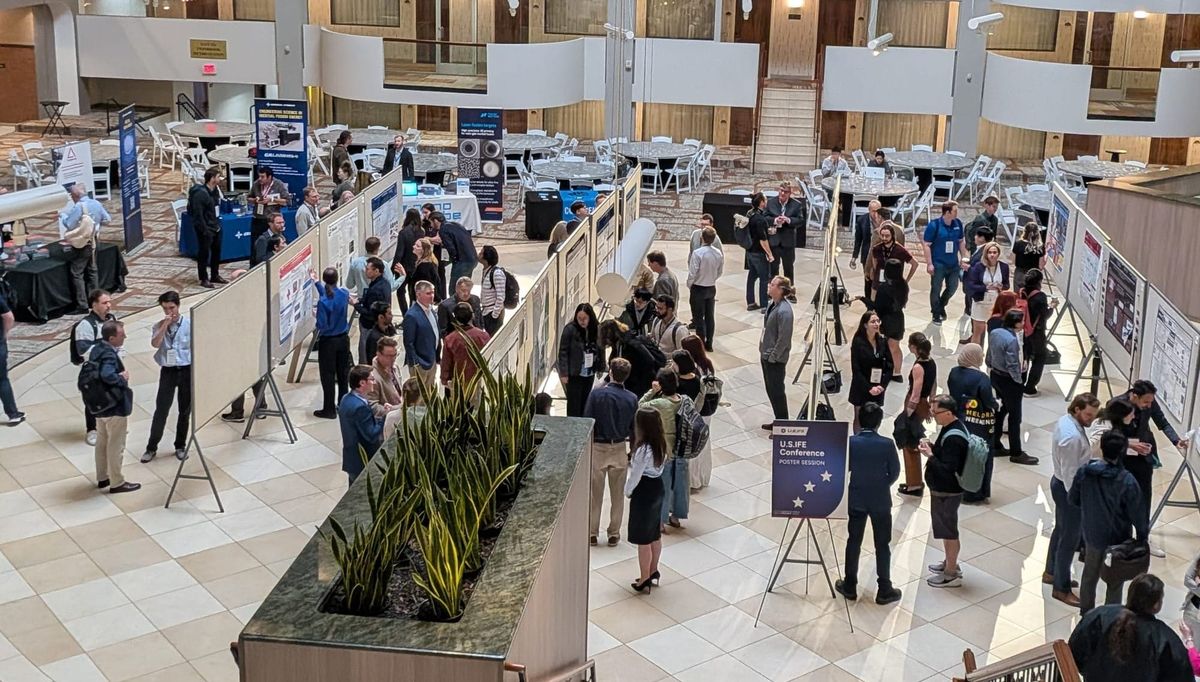
The scale of this mobilization was visible at the 2026 U.S. IFE Conference. Nine national laboratories sent speakers. Six private companies presented on the main stage, a qualitative shift from previous years when private IFE ventures were audience members, not presenters. The UK, Germany, and Japan each sent institutional delegations. Five universities presented work spanning everything from facility construction to social science. System engineering received its own dedicated session for the first time, pairing a national lab spinout, a European research organization, and an American startup on industrialization pathways. Two years ago, that session would not have existed.
This is not a loose collection of research projects. It is a coordinated international effort with structure, funding, and institutional will.
The gap table
The honest way to measure distance is not by counting milestones achieved, but by listing gaps remaining. Here is what the data shows:
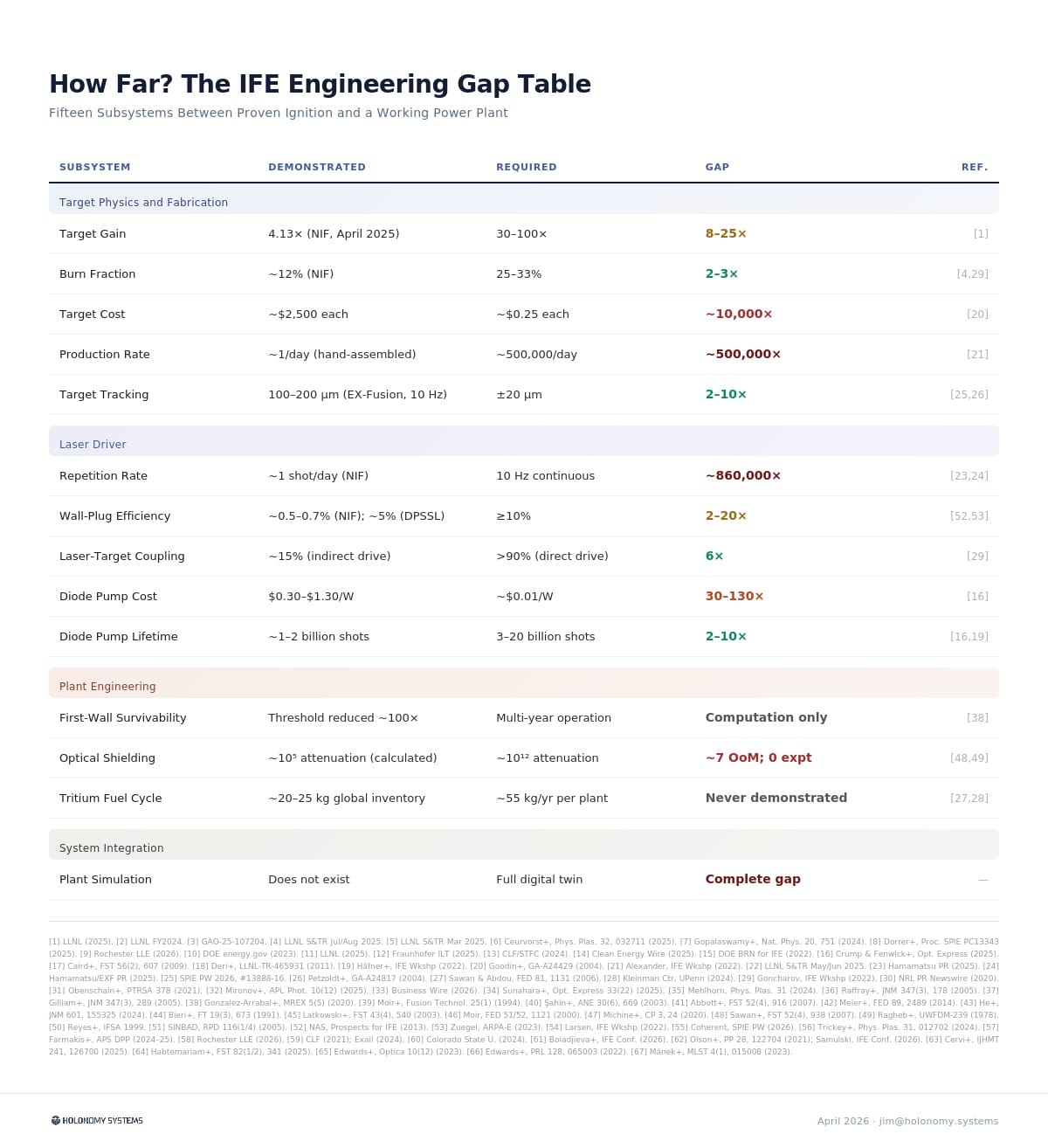
Every number in the "Demonstrated" column comes from a published, verifiable source. Every number in the "Required" column comes from DOE workshop reports or peer-reviewed design studies.
Three patterns worth noting
The table is dense. Three patterns stand out.
The manufacturing gaps dwarf the physics gaps. Target gain needs to improve 8–25×. That is a hard physics problem, but it is a problem measured in single-digit multiples. Target cost needs to improve 10,000×. Target production rate needs to improve 500,000×. The physics of fusion ignition has been demonstrated. The manufacturing infrastructure to make it repeatable at power-plant rates has never been attempted.
Today's NIF targets are hand-assembled objects that cost $2,500 each and take a week to fabricate. A power plant needs half a million per day at twenty-five cents each. LLNL has demonstrated the first 3D-printed wetted-foam capsules on NIF, which is a genuine breakthrough. But two-photon polymerization currently takes 24 hours per capsule. Scaling to 500,000 per day requires either massive parallelization with 100,000-focal-point metalens arrays (demonstrated only at prototype scale) or chemical microencapsulation (100–1,000 capsules per minute in the lab, never at production quality). General Atomics has designed a conceptual target factory at $97 million installed capital. It is entirely unbuilt. At the conference, Daniel Casey of LLNL presented on implosion degradation mechanisms with "IFE-Relevant" explicitly in the title, and EX-Fusion's Max Monange reported 100–200 μm tracking accuracy sustained for over one hour at 10 Hz. The community is working on these problems. But the distance from laboratory demonstration to factory production remains immense.
The deepest validation deficits are in plant engineering, not target physics. Three critical subsystems, first-wall materials, optical neutron shielding, and tritium breeding, have proposed solutions that exist only as computation. No liquid-wall chamber has ever been tested with molten FLiBe. No IFE beam-line geometry has ever been experimentally validated for neutron shielding. No fusion device of any kind has ever demonstrated tritium breeding.
The tritium constraint is particularly underappreciated. Global civilian tritium inventory totals 20–25 kg, decaying at 5.5% per year. A single 1 GW plant would consume 55.6 kg per year. Every plant must breed its own tritium at a ratio exceeding 1.1. The integrated fuel cycle, from target injection through burn, exhaust processing, tritium extraction, and re-fueling, remains entirely undemonstrated at any scale.
The simulation gap is total, but beginning to close. No integrated, predictive whole-plant simulation currently exists for IFE. Existing codes are siloed in weapons programs, require post-shot tuning, and cover only target physics. The system-level digital twin that couples driver, target, chamber, blanket, and fuel cycle in a single predictive model does not exist. But purpose-built IFE tools are emerging: PulseFoam, the first open-source chamber dynamics solver validated against experimental data (Best Paper at the 26th TOFE), and machine-learning surrogate models achieving eight-million-fold speedups for tritium breeding ratio prediction. At the conference, the simulation and AI-ML track ran six talks across two sessions, including a plenary by Brian Spears of LLNL on the Genesis Mission. AI is becoming an accelerator for IFE, not merely a tool.
How far: an honest assessment
The gap table reveals a community that has moved decisively from "can we ignite" to "can we engineer a power plant." That transition is itself a milestone.
The conference made this visible in a way that published literature cannot. The inaugural IFE-STAR Conference in 2025 ran five days in Breckenridge with over 200 attendees and no dedicated sessions on chamber engineering, materials science, tritium systems, or final optics. One year later in Washington DC, the 2026 conference expanded to six days, and all four of those topics appeared on the agenda. The international footprint expanded from one French co-author to institutional delegations from three countries. Target-physics talks retained the most stage time, but their framing shifted from ICF science to explicitly IFE-oriented design. Inertia's Mike Dunne presented a pilot plant roadmap. Fraunhofer's Constantin Häfner presented a risk-based industrialization framework, approaching IFE from manufacturing readiness rather than physics discovery. The trajectory is unmistakable: a community broadening its institutional base as it moves from ignition celebration to engineering feasibility assessment.
But the honest assessment demands acknowledging what the table shows. Every critical subsystem carries a gap measured in factors, and many are measured in orders of magnitude. Several proposed solutions have never been tested under IFE-relevant conditions. The integrated plant simulation that would connect all subsystems into a single predictive framework does not exist.
The most aggressive private-sector roadmap projects a pilot plant in the mid-2030s. European institutional estimates place a demonstration plant around 2045. The truth likely lies between these two, contingent on the magnitude of sustained investment and successful demonstration of at least one complete laser driver architecture at costs two orders of magnitude below current levels.
What defines the remaining distance is not physics uncertainty. The physics path through broadband direct drive is credible. What defines the distance is the absence of an industrial base.
Target factories that do not exist. Diode production lines at a scale that has never been attempted. Chamber materials tested only in simulation. Tritium breeding demonstrated only on paper. Optical shielding architectures refined through 45 years of computation but zero years of experiment.
These are solvable problems with known physics. But they require companies that do not yet exist to build products that have never been standardized, manufactured, or fielded.
Where the cost curve meets the supply chain
Among all fifteen gaps, one has a distinctive structural property: it sits on a known, measured cost curve.
Laser diode pump modules have followed a verified 60% learning rate for four decades, from $2,000 per watt in 1987 to $0.30–$1.30 per watt today. The path to the $0.01/W that IFE requires needs approximately ten more doublings. As Crump and Fenwick of the STARFIRE Diode Technology Working Group concluded in their December 2025 analysis, reaching this target is "highly likely" based on learning-curve models, but requires a roughly 1,000-fold increase in demand.
The chicken-and-egg problem is real, but it has a structural solution. Defense directed-energy programs pay premium margins for the first production runs. Industrial and scientific laser applications fund the middle doublings. Each market funds the cost reduction that opens the next. IFE is the natural endpoint of a cost curve that near-term customers are already funding.
But the cost curve requires a specific product that does not yet exist: a standardized, independently manufactured laser diode pump module. Today, pump modules are captive subsystems inside vertically integrated laser companies. Packaging, which constitutes well over half of total diode cost, remains largely manual. The structural vacancy between the semiconductor die and the laser system, the packaging layer that could ride the learning curve if standardized, has persisted for nearly seven years. No incumbent has reason to fill it, because standardization erodes the margins their integration protects.
At the conference, this structural vacancy was confirmed by what was absent from the agenda. Fenwick and Nelson presented on diode cost and lifetime requirements, the demand side. The supply side, who builds these modules as standardized products at scale, was not represented on stage. No company or program presented a manufacturing roadmap for the 50 million diode bars a single power plant requires.
At Holonomy Systems, this is the gap we are building to fill. The full analysis behind these findings is available as a white paper: How Far? A Quantitative Assessment of the Engineering Gaps Between Proven Fusion Physics and a Working IFE Power Plant.