What TechNatSec 2026 Told Me About Where Defense Tech Is Really Headed

I spent two days at the Harvard & MIT Technology and National Security Conference last week. The lineup was strong: Gen. CQ Brown (21st Chairman of the Joint Chiefs, Ret.), Matthew Steckman from Anduril, Brandon Tseng from Shield AI, a venture capital panel with Dan Gwak (In-Q-Tel), Chip Walter (Marlinspike), Laura Rippy (Alumni Ventures), and Matt Cronin (a16z). Breakout tracks covered drones and autonomy, supply chain, advanced manufacturing, geopolitics, and defense policy in Massachusetts.
It was a well-run conference. But the most useful things I took away weren't from any single panel. They were patterns that emerged across sessions, and one notable absence.
The Orthodoxy: Build Outside Defense First

The most repeated piece of strategic advice across the entire conference, from investors and operators alike: defense startups should find commercial or adjacent-market customers before pursuing defense contracts. Build revenue. Prove operational credibility. Then engage the DOD from a position of strength rather than dependence.
This came up in the VC panel. It came up in the supply chain track. It came up in hallway conversations. The unanimity was striking.
I agree with this advice, but I think it deserves a sharper framing than "survive while you wait for the government to buy."
For deep-tech hardware companies, adjacent markets aren't a holding pattern. They're where you build resilience. Multiple revenue streams mean your company doesn't die when a single program gets delayed or defunded. Battle-tested manufacturing processes mean you've already solved the yield and quality problems before a defense customer needs to depend on you. A supplier base that serves multiple end markets doesn't collapse when one procurement cycle stalls.
A company that only sells to defense is fragile. Its revenue depends on a single buyer with unpredictable timelines and political exposure. A company that serves multiple markets and brings that operational maturity to defense is durable. It can absorb procurement delays without existential risk. It can invest in manufacturing improvements funded by commercial revenue. It can attract talent that wants to build products people actually use today, not five years from now.
The dual-market approach isn't a concession to a broken procurement system. It's a structural advantage. The best defense suppliers have always been companies that also serve other demanding customers. The aerospace primes didn't start as defense-only shops. They built competence across markets and brought that depth to national security applications.
The fact that this advice has become orthodoxy at defense tech conferences tells you something about where the procurement system stands: it hasn't changed enough for "build for defense first" to be a viable path for most hardware startups. That's not a complaint. It's a design constraint. Build accordingly.
Where the Real Depth Was: Supply Chain and Manufacturing
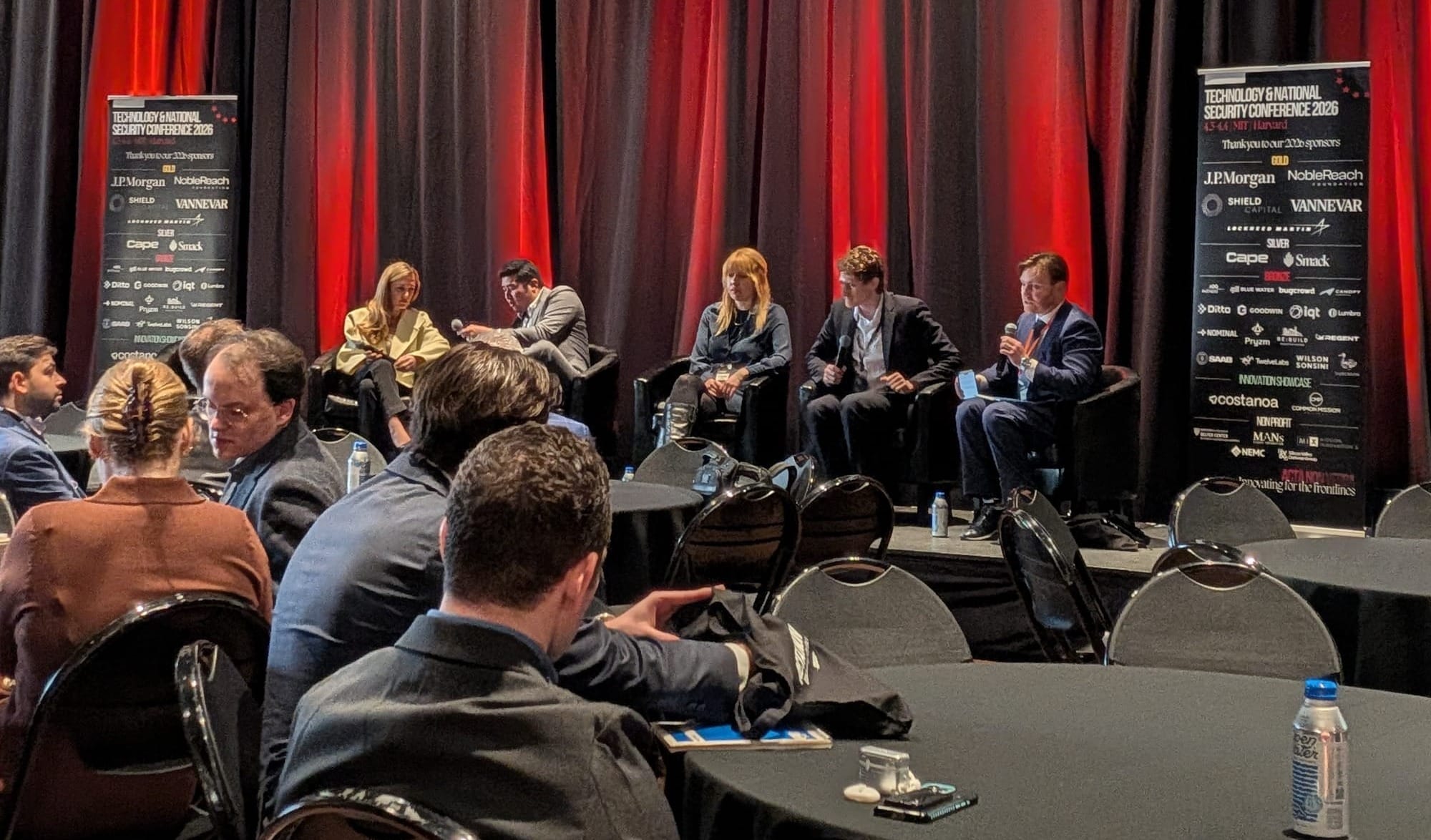
The panels that felt most forward-looking weren't about platforms or software. They were about the physical infrastructure of making things.
The supply chain track featured founders from SolidIntel, Vulcan Elements, Minerva Tech Futures, and Canopy Aerospace. The advanced manufacturing track brought in Lukas Czinger from Divergent, along with panelists from Firestorm Labs and others. These sessions were the most operationally grounded of the conference. The conversations centered on tooling, yield, vendor qualification, and the unglamorous work of turning a working prototype into a reliable production line.
This matters because defense tech has spent the last decade answering one question: can startups build great products for national security? The answer is clearly yes. Anduril, Shield AI, and dozens of others have proven it.
The question now is harder: can the industrial base manufacture these products at the scale and reliability the mission demands?
That's a fundamentally different problem. Product innovation rewards speed, iteration, and technical creativity. Manufacturing at scale rewards process discipline, supply chain management, capital efficiency, and the kind of institutional knowledge that accumulates slowly over years of production. These are different muscles. Most defense tech startups have only exercised the first set.
The companies that will define the next era of defense innovation are the ones solving manufacturing problems, not just design problems. The supply chain and advanced manufacturing panels at TechNatSec felt like early indicators of this shift. The founders in those rooms weren't pitching concepts. They were talking about production capacity, supplier relationships, and the hard logistics of getting hardware from a factory floor to a forward operating base.
The Costanoa Innovation Showcase: It's Time to Build, Literally

The conference included an Innovation Showcase sponsored by Costanoa Ventures, where founders pitched real products on stage. Spaceflux (optical space situational awareness, London-based, sole provider of optical SSA data to the UK government). AMROK (autonomous spacecraft docking). Vectorwave (moving intelligence to the signal itself, at the chip level). Bandelier Technologies (quantum sensing for national security). Prodex Labs (operational digital twin decision engines for manufacturers).
What stood out wasn't any individual company. It was the pattern: hardware companies solving specific, well-defined problems with working technology. No vaporware. No "we're building a platform for everything." Each founder had a clear technical thesis, a clear customer, and a product that either existed or was close to existing.
This is what "it's time to build" looks like when it stops being a slogan and becomes a room full of founders who showed up with hardware. The energy in the showcase was different from the panel discussions. Less theoretical, more operational. These companies are past the "should we build for defense?" question. They're deep in the "how do we manufacture, qualify, and deliver?" phase.
The Silence: Directed Energy
One absence was notable. In a year where every military branch is accelerating directed energy weapon programs, and counter-UAS remains one of the most urgent operational challenges, there was no dedicated panel on directed energy or counter-UAS laser systems at the conference.
This could mean several things. It could mean directed energy has moved past the debate phase into quiet execution, where the interesting work is happening inside classified programs and prime contractor facilities rather than on conference stages. It could mean the defense tech startup community, which has been strongest in software, autonomy, and drones, hasn't yet developed the vocabulary or the network to discuss the hardware manufacturing challenges underneath directed energy systems.
I suspect it's a bit of both. Directed energy is at an awkward stage: too real to be speculative, too hardware-intensive to fit neatly into the software-first defense tech narrative, and too dependent on supply chain and manufacturing infrastructure that doesn't fully exist yet. The components that make a high-energy laser work (the pump diodes, the gain media, the beam combining optics, the thermal management systems) are deep in the industrial stack, far from the autonomy and AI conversations that dominate defense tech discourse.
This gap between the urgency of directed energy programs and the absence of directed energy from defense tech conversations is itself a signal. The systems are being built. The manufacturing base to build them at scale is not yet in place. And the community that could help build that base isn't yet focused on the problem.
What I'm Taking Away
Defense tech is maturing. The conversations are shifting from "can startups serve national security?" to "can the industrial base produce at scale?" That's progress.
The companies worth watching aren't necessarily the ones with the most funding or the flashiest demos. They're the ones solving manufacturing and supply chain problems: the unsexy, unforgiving work of building production capacity that the defense base actually needs.
The dual-market strategy isn't a workaround. It's a structural advantage for any hardware company serious about long-term resilience.
And the areas where the conversation hasn't yet caught up to the operational need (directed energy being a prime example) are exactly where the biggest opportunities for new entrants sit. The absence of discussion doesn't mean the absence of demand. Sometimes it means the opposite.