SPIE Defense+Security 2026: When Defense and Fusion Stop Being Two Conversations
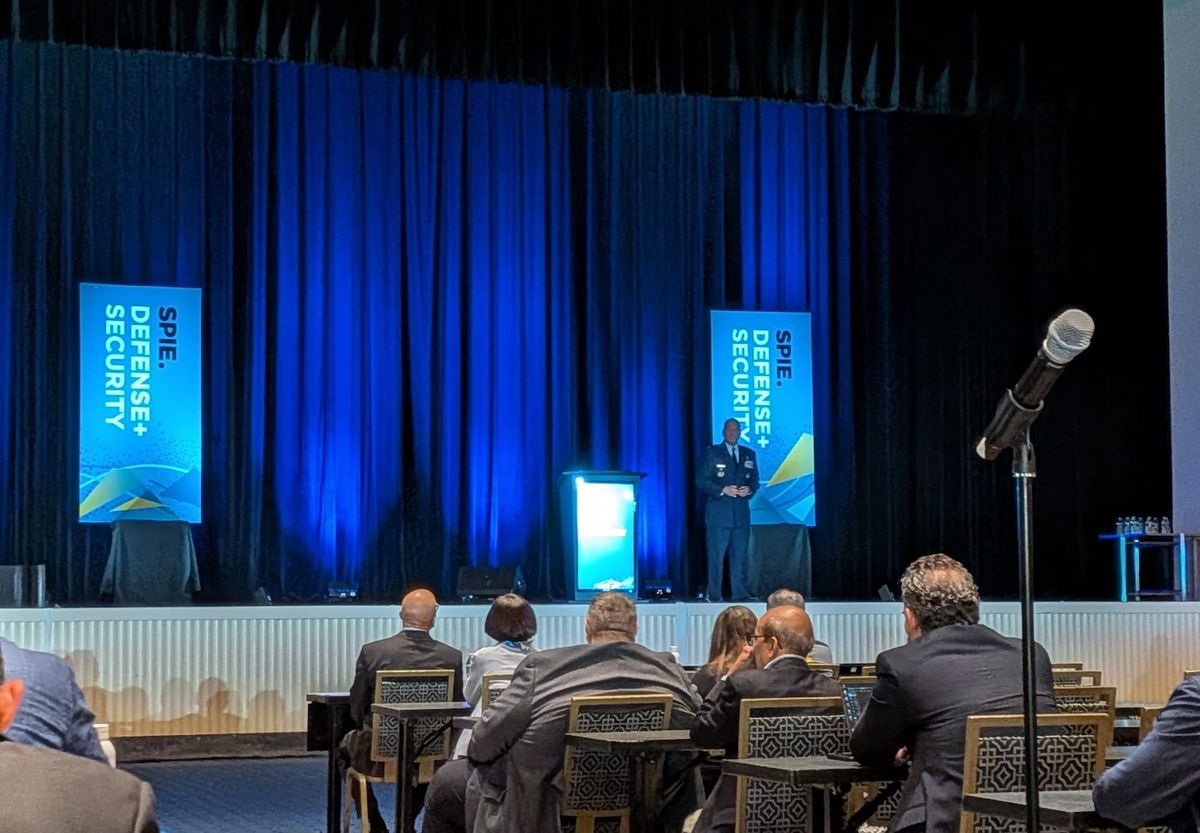
At a single industrial panel last week in National Harbor, three speakers shared a stage: a directed energy academic from the University of Arizona, a fusion-and-semiconductors academic from the same institution, and the most established U.S. manufacturer of high-power diode laser pump modules. Three roles, three institutional homes, three different decade-long careers. One technical conversation.
That panel is the cleanest signal I saw all week that something has shifted in how the U.S. defense laser ecosystem and the inertial fusion energy community are starting to think about each other. They are still distinct communities with distinct funding streams and distinct cultural codes. But the upstream supply chain they depend on is converging fast, and the institutions that move first to recognize that convergence are positioning themselves for a decade of advantage.
From parallel tracks to one frame
For most of the last twenty years, defense laser systems and inertial fusion drivers have been parallel conversations that occasionally borrowed components from each other. Defense had its programs at AFRL, MDA, and the Pentagon's directed energy office. Fusion had NIF, the National Ignition Facility, and the slow physics-first work of getting to ignition. Different review cycles, different conferences, different career paths.
The December 2022 ignition demonstration at NIF, followed by the Department of Energy's $42 million IFE-STAR program a year later, put fusion on a commercialization timeline. That alone would have been interesting. What's making the convergence concrete is that the manufacturing problems blocking IFE at scale are the same manufacturing problems defense laser programs have been working on for two decades: cost-effective laser diode fabrication, packaging reliability, lifetime testing, frequency conversion at large aperture. The technical map overlaps. The procurement community is starting to behave like it.
Three signals from the technical sessions
Three other sessions at SPIE D+S reinforced the convergence from independent angles.
Laser power beaming has stepped outside the lab. Physical Sciences Inc. presented Army STTR Phase II results on 1075 nm laser power beaming to Group-1 drones, with 51% photovoltaic conversion at the airborne receiver and a system that is demo-ready. The architecture is a diode-pumped fiber laser with a tailored InGaAs receiver. It is a defense application, but the underlying technology stack is the same one fusion drivers will need to scale.
Coherent beam combining is moving to the chip level. UTA's Weidong Zhou demonstrated coherent PCSEL arrays at 1040 nm, power-scaling at the chip level rather than the system level through Q-k engineering. PCSELs are surface-emitting lasers that combine coherently across an array, which means brightness scales without the optical complexity that bulk crystal architectures impose. For fusion drivers, that opens a path that does not currently exist in the production toolkit.
Frequency conversion is becoming a product, not a science project. Gamdan Optics, with University of Rochester's Laboratory for Laser Energetics, presented diffusion-bonded LBO at 360 mm aperture, NIF-class, funded under NNSA's inertial confinement fusion program. The third-harmonic conversion bottleneck that every laser fusion facility has hand-built since the 1980s is on its way to becoming an off-the-shelf component. That is what infrastructure formation looks like.
The institutional bet
The University of Arizona's industrial panel was the institutional version of the same shift. The University has assembled a deliberate position across the three layers that the convergence demands: optics (Wyant College of Optical Sciences, the largest optical sciences program in the country), directed energy (Mark Spencer's Beam Control and Propagation Lab, with Spencer arriving from Acting Principal Director for Directed Energy at the Office of the Under Secretary of Defense for Research and Engineering), and fusion commercialization (the Fusion Energy Initiative under Horst Hahn).
Hahn's timeline is the tell. He arrived March 2025 from KIT in Germany. By May he was leading a UA delegation to Lawrence Livermore. By September UA had joined the IFE STARFIRE Hub. By February 2026 they were hosting Arizona-Livermore Days in Tucson. Six months from recruit to federal hub seat is fast for any university, and it tells you the institutional commitment is real, not aspirational.
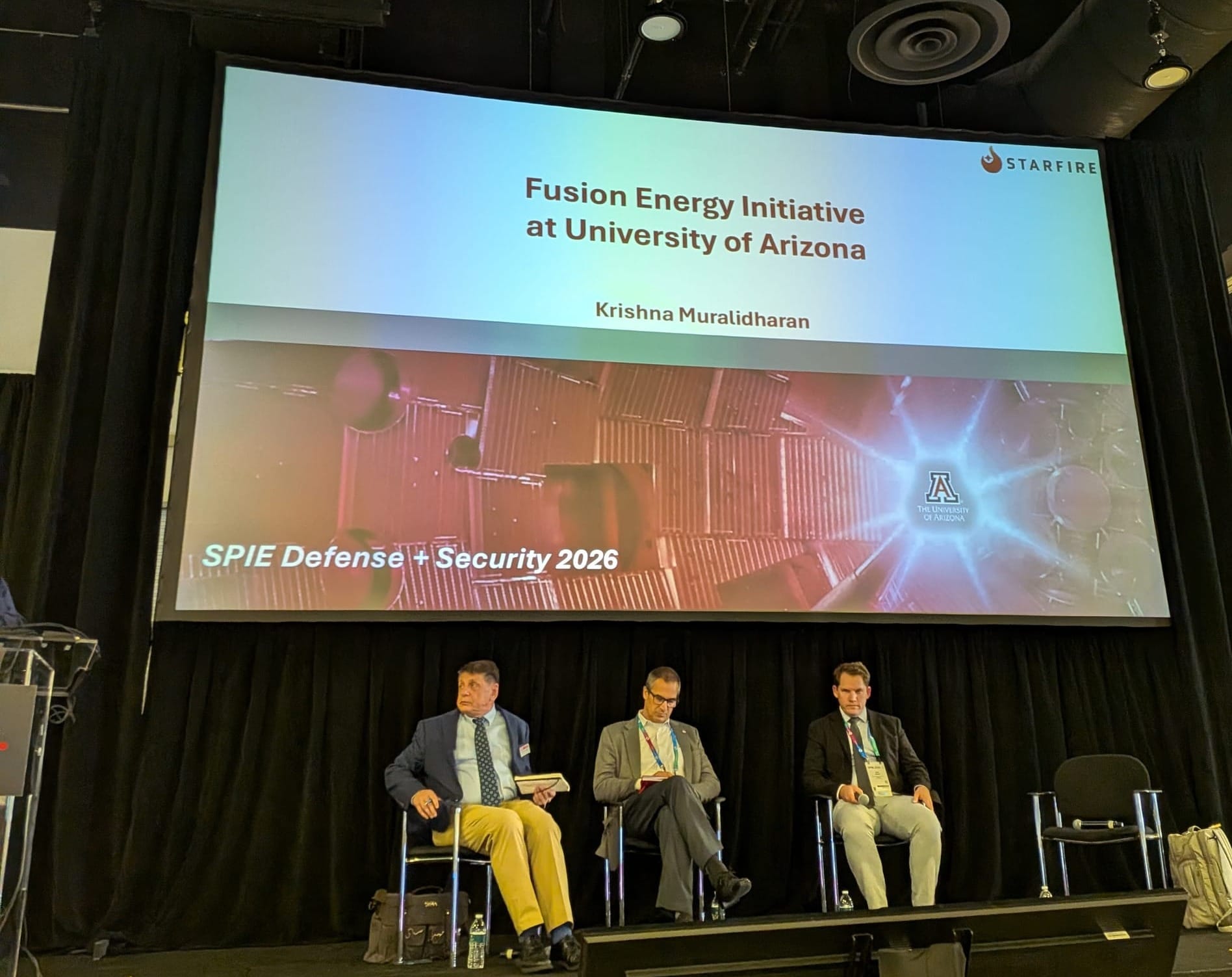
The Taiwan piece is the part most observers will miss. Krishna Muralidharan, who appeared on the SPIE panel alongside Spencer, directs UA's Center for Semiconductor Manufacturing. That Center is the operational anchor for UA's January 2026 MOU with National Yang Ming Chiao Tung University, signed by President Garimella in Taipei to launch the Talent and Innovation Hub. UA is not just building a fusion play. They are building it on a U.S.-Taiwan supply chain bridge that includes compound semiconductors, advanced packaging, and photonics, exactly the manufacturing layer the defense-fusion convergence demands.
The platform question is now open
The convergence settles the demand question. The supply question is just beginning to be contested.
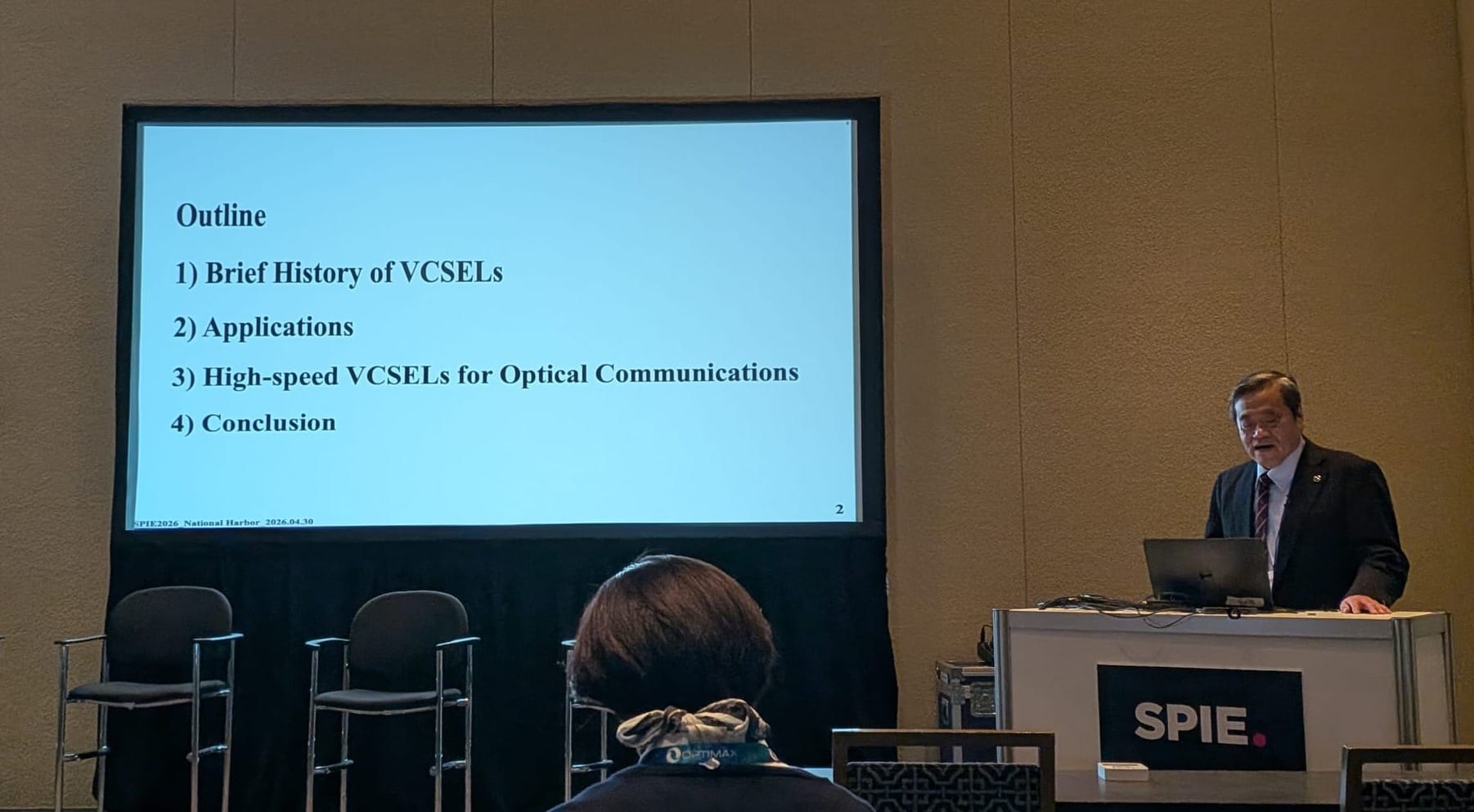
The talk I sat with longest was Fumio Koyama's 50-year retrospective on VCSEL. The IEEE awarded the technology its Milestone Plaque last October. Multi-junction designs have reached 74% wall-plug efficiency under pulsed operation, beyond what the best edge-emitting bars achieve. Koyama's canonical application wheel listed datacom, sensing, printing, medical, interconnects. Defense, directed energy, and fusion were not on it.
That is the structural opening. Surface-emitting laser platforms have matured into infrastructure for five major industries that all started as research curiosities. The defense-fusion convergence is the next industry. The question is who builds the packaging layer that connects the platform to the markets pulling on it hardest.
That is the bet I am here to make.